Space Information Lab Implements CME Pneumatic Vertical SRS Test System
A High-Precision Shock Testing Solution for Future Aerospace Reliability Validation
Customer: Space Information Lab (SIL)

Industry: Aerospace and Space Equipment Manufacturing
Application: Shock Response Spectrum (SRS) Testing
Equipment: CME KRD14-50 Pneumatic Vertical SRS Test System
Challenge
With the rapid development of aerospace technology, satellites, space exploration equipment, aerospace electronic systems, and precision payloads are facing increasingly strict requirements for mechanical environmental reliability.
During spacecraft launch and operation, equipment may experience transient shock environments caused by rocket engine ignition and shutdown, stage separation, structural release, and other dynamic events. These shocks usually feature high frequency, short duration, and complex dynamic responses, which may cause damage to internal electronic devices, precision instruments, and critical structures.
Traditional shock tests mainly focus on peak acceleration and pulse duration. However, these parameters alone cannot fully evaluate the dynamic response characteristics of aerospace products under complex shock environments.
Shock Response Spectrum (SRS) testing provides a more comprehensive evaluation method by analyzing structural responses across different frequency ranges during shock events. It has become an essential testing method for future aerospace equipment reliability validation.
Space Information Lab required a high-precision SRS testing solution to support future space equipment development and reliability verification.
Key challenges included:
Simulating complex aerospace shock environments;
Obtaining accurate dynamic response characteristics of products;
Maintaining excellent test repeatability;
Supporting space equipment reliability validation;
Providing reliable data for structural optimization and product improvement.
Solution
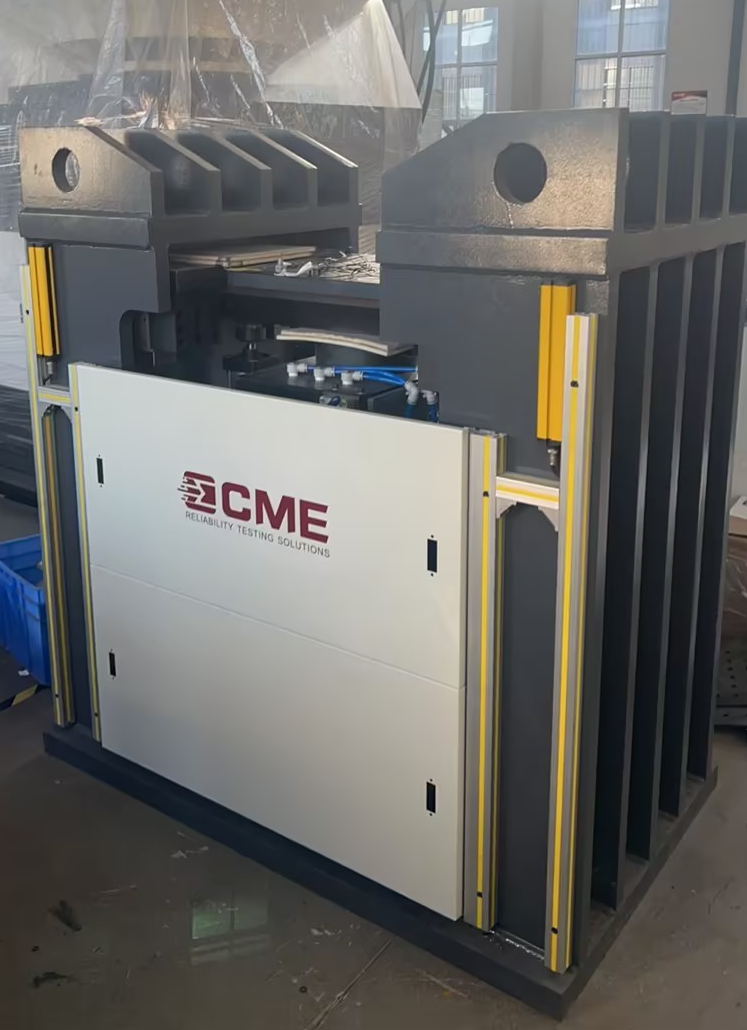
To address Space Information Lab’s requirements for high-precision Shock Response Spectrum testing, CME provided the KRD14-50 Pneumatic Vertical SRS Test System.
The KRD14-50 is specially designed for spectrum standard shock testing. The system generates controlled shock excitation through a pneumatic energy storage and impact mechanism, while the response plate and waveform generators create the required dynamic response characteristics for SRS testing.
The system uses an expansion shock cylinder as the power source. By adjusting the air pressure, different impact energy levels can be achieved. The shock head, response plate, and waveform generator form a two-degree-of-freedom spring-mass system. By calculating and adjusting the waveform generator stiffness, mass ratio, and air pressure parameters, complex shock spectrum waveforms can be generated to meet test requirements.
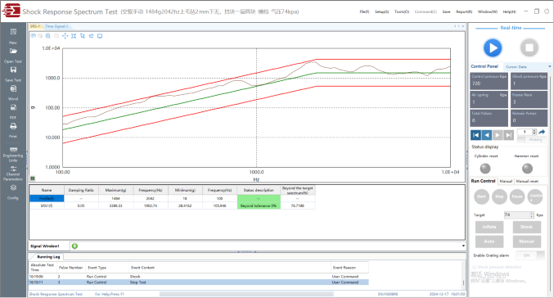
The complete system consists of the mechanical test unit, control and measurement system, high acceleration sensor, and data analysis software. The system processes acceleration time-history data into shock response spectrum results and compares them with the target spectrum specification.
Solution Advantages
High-Precision SRS Testing Capability
The KRD14-50 performs shock response spectrum standard testing and meets the requirements of aerospace shock testing standards including MIL-STD-810.
The system provides a maximum response acceleration of up to 10,000g and a response frequency range of 10Hz to 10,000Hz, enabling evaluation of complex shock environments.
Future-Oriented Testing Technology for Aerospace Development
As aerospace systems become increasingly complex, SRS testing will play a more important role in validating satellites, aerospace electronics, and precision payload reliability.
The KRD14-50 provides an advanced shock environment testing platform designed to support future aerospace development requirements.
Excellent Test Repeatability
The system uses high-precision pressure measurement and stable pneumatic control technology to achieve consistent impact energy and excellent shock spectrum repeatability.
Waveform Generator Design
The system uses elastic waveform generators installed on both ends of the response plate to generate complex shock waveforms.
By adjusting waveform generator stiffness, the mass ratio between the shock head and response plate, and the stored air pressure, the system can generate shock response spectrum waveforms that meet specific test requirements.
Compact System Design
Compared with large-scale shock testing facilities, the KRD14-50 features a compact structure and small installation footprint.
The system dimensions are approximately 1530mm × 920mm × 1650mm, and no special foundation is required. The equipment can be installed directly on a flat concrete floor.
Suitable for Various Aerospace Product Testing Applications
The system is suitable for reliability validation of:
Satellite components;
Aerospace electronic equipment;
Space payloads;
Small military equipment;
Precision electronic products.
SRS Testing Capability
The main technical capabilities of the KRD14-50 include:
Rated load: 50 kg (including fixtures, test specimens, and sensors);
Maximum response acceleration: 10,000g;
Response frequency range: 10Hz–10,000Hz;
Table size: 500mm × 500mm.
During testing, the specimen is mounted on a response plate with defined stiffness. The acceleration sensor collects the response acceleration of the plate, and the system performs shock response spectrum analysis.
Results
By implementing the KRD14-50 Shock Response Spectrum Test System, Space Information Lab successfully established advanced SRS testing capability.
Enhanced Aerospace Product Validation Capability
Through SRS analysis, the system provides a more comprehensive evaluation of product dynamic response performance under complex shock environments.
Supporting Future Space Equipment Development
The system provides a reliable mechanical environment testing platform for satellites, aerospace electronic equipment, and high-reliability space products.
Improved Test Data Reliability
Stable and repeatable SRS test results provide reliable data support for structural optimization and product reliability improvement.
Increased Development Efficiency
The efficient testing process enables engineering teams to complete product validation under different test conditions more quickly.
Meeting Future Aerospace Testing Requirements
With the continuous development of aerospace technology, SRS testing will become an increasingly important method for space equipment reliability validation.
By adopting the CME KRD14-50 SRS Test System, Space Information Lab obtained a high-precision, stable, and reliable Shock Response Spectrum testing solution, providing essential technical support for future aerospace equipment development.